Group A isn’t a straightforward affair. There will be many who look at this group and automatically assume that hosts Germany will top it, Scotland will come bottom and Switzerland will just do what they do and qualify for the knockouts before being humbled.
People may look at Hungary, who don’t qualify with any consistency to major tournaments and assume they’re not up to much. However, there have been notable performances since the appointment of Marco Rossi back in 2018. During Euro 2020, while they did not make it out of the group, they impressed many after being drawn against France, Germany and Portugal, only losing to the latter. For the 2024 edition of the Euros, Hungary qualified without losing a single game. The Nations League has also proved fruitful for the Hungarians, doing the double over England and also beating Germany in Leipzig.
The squad that Rossi has at his disposal is not full of stars, nor is it full of game changers, similar to those of the 1950’s. Instead, there is a fine balance of youth and experience that has been well-coached for the past few years that won’t be considered by many to pose a threat. Tournament football dictates that those who go far have to be defensively astute and work as a collective. In the heart of the defence for the Magyars is Márton Dárdai, the 22 year old who plys his trade at Hertha Berlin, Germany’s second tier.
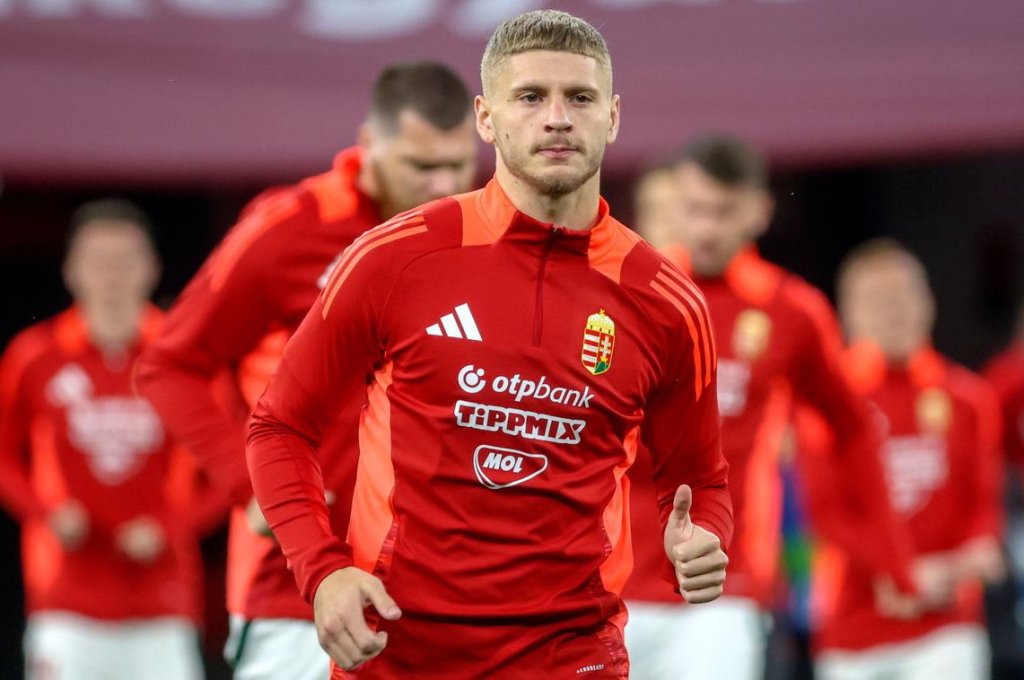
Márton Dárdai, 22 (Hungary/Hertha Berlin)
Dárdai is predominantly a centre-back, who can also operate within a midfield too. Left-footed centre-backs are usually well sought after but he has been at Hertha since graduating through the youth system. Hertha operate, on most occasions, a fairly standard 4-3-3 system, with Dárdai deployed on the left-side of a centre-half partnership. Hertha finished mid-table in the second tier of German football and have definitely not fought back in the way people thought they might since their relegation in 2023. Among the poor performances for Hertha, there have been some positives, such as those of Márton Dárdai who has been almost ever present and started 27 league games this season. The numbers themselves look pretty promising though, so let’s get into them.
Hertha’s number 31 has featured for 2,271 minutes this season in 2. Bundesliga which is a good sample size to look at some of his underlying numbers. Since relegation, Hertha’s performances have by no means been great and it looks to be a long time before they will be back up in the top-flight again. In all games which Dárdai featured in, there were only five clean sheets, which will understandably look poor. However, the underlying numbers show a very busy defender who may not have been protected well by his defence and may also show how Hungary can benefit from him this summer.
When comparing data with other centre-backs in FBRefs “Next 14 Competitions” a couple of things stood out. One would be the defensive output and the next would be the progressive actions.
Firstly, the defensive output and on looking at where Dárdai features amongst similar players this season, it’s not difficult to see that he has been under a lot of pressure from opposition attacks. In over 2,000 minutes of league football this season, he has averaged 1.62 blocks and 1.62 interceptions placing him in the 86th and 88th percentile respectively for those of these stats. The blocks is fairly self-explanatory and shows he is able to get his 6ft 2 frame in front of shots and read those shots too. This slows an alertness to danger but also a desire to put his body on the line, something that is going to be required if Hungary are going to progress in this tournament. Interceptions is similar in that it requires a reading of the game and an understanding of how play is built up from oppositions offences. Not only that, but also shows that his positioning is key too. In order to be able to intercept, your positioning has to be good front the start and this again shows he is smart off the ball and displays strong concentration too.
The final point to pick out would be his progressive passing that he has done for Hertha this season. To progress in the Euros, Hungary will need to first be good at the back but to win you need to score. Progression from the back is key and any defender who can play the ball forward will be key to success. At club level, Dárdai is not coached to keep the ball, or at least the average passes per 90 do not indicate that. However, when he does have the ball he is trying to find those passes that can start attacks. During the season he averaged 4.12 progressive passes per 90, which scores within the 78th percentile. A progressive pass is defined by any pass that enters the opposition box or advances the ball at least ten yards forward from the previous six passes – these can never be from the defensive 40% though. In short, he is able to pick out passes that have pushed his team forward. Despite finishing 9th, Hertha were the 2nd top scoring team in the division behind play-off losers Fortuna Düsseldorf. He achieved an average of 1.23 shot-creating actions (SCA) per 90 last season, these are defined by any two offensive actions leading to a goal such as passes, take-ons or drawing fouls.This is particularly high per 90 for a centre-back and means he scores within the 90th percentile for this statistic. Tournament football can be cagey and full of players not wanting to take risks like Dárdai has shown this season for Hertha.
While Hertha have not been overly successful this season, it is clear that Dárdai is potentially ready to move on and this tournament could be a chance to show that. He only has one year remaining on his current contract and it may well be time to leave his hometown Berlin behind. Dárdai will also be leaving two brothers at Hertha, Palkó and Bence. Leaving may well be tough for a few reasons but Hertha are not likely to progress at the same rate as him.
*All statistics taken from FBRef website. FBref includes scouting reports based on the last 365 days and each individual domestic league season. Márton Dárdai has been compared against other players in the “Next 14 Competitions”, these include leagues such as; English Championship, Portuguese Primeira Liga, Dutch Eredivisie and more.


 Statswise FC