
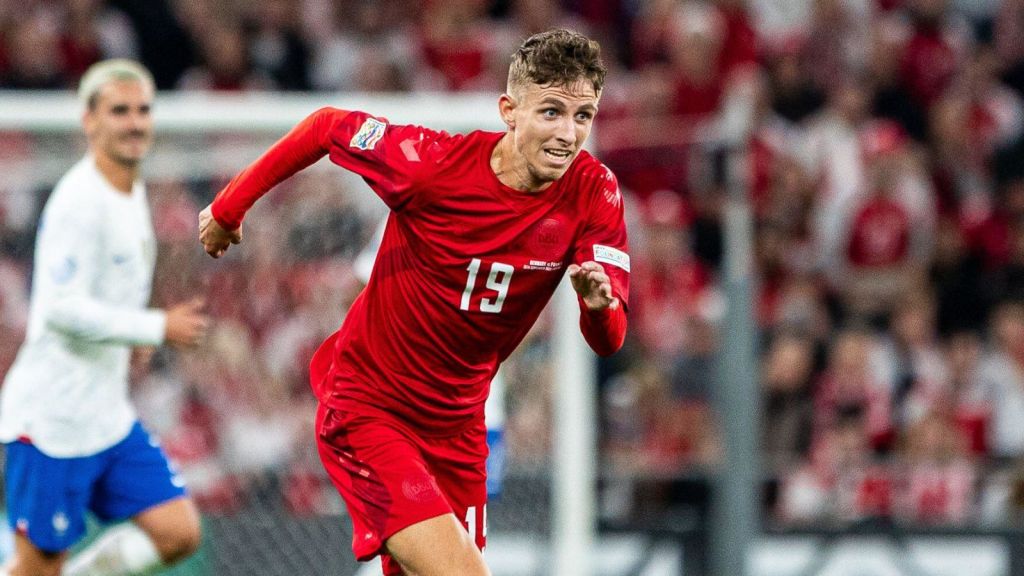
Group D could well be the easiest to make assumptions on. On the face of it, we are expecting France and Denmark to make it to the last 16. Australia and Tunisia are capable of causing problems on their day, the latter coming very close to a credible draw vs England in Russia. Australia too were close to getting a result vs France, who they will have to face once more. The reigning champions will be expected to qualify despite apparent unrest in the camp – what’s new? Denmark made it to the semi-finals of the Euros last year too, proving a very canny operator in the knockout stages.
We will be focusing on Denmark, in what will be their sixth entry into the tournament. Hardly believable that it’s only their sixth entry, especially given their standing in the game. In 1992 they won the Euros, but have never been able to replicate that at the World Cup. Denmark’s best ever finish at the tournament coming in 1998 when they were beaten by eventual runners-up Brazil. The tournament in ‘98 they were also grouped with France, losing 2-1 in Lyon – France of course would go on and win the tournament. Coach Kasper Hjulmand has been experimenting throughout the Nations League campaign, which has proved fruitful with a double over France. At the Euros we were used to seeing Denmark line up with three at the back, or five if you prefer with wing-backs. Seemingly he has now settled on a four at the back system, however the attacking players can often be setup in different fashions, sometimes playing narrower or in a rudimentary 4-3-3. If they are to deploy either of those systems then Jesper Lindstrøm should be able to provide them with the flair they need.
Jesper Lindstrøm, 22 (Denmark/Eintracht Frankfurt)
Lindstrøm joined his current club Eintracht Frankfurt ahead of the 21/22 season after playing in the Danish top-flight for Brondby. He only has six caps for his nation but his stats over the last year and 22/23 season especially have been particularly impressive. Lindstrøm would best be described as a rangy attacking-midfielder who has a tendency to drift towards the flanks, particularly the right. On rare occasions he is deployed on the right-wing.
He’s had a particularly strong start to the season, although he has not produced any assists as an attacking midfielder in 13 games in the Bundesliga, he has bagged six goals. Besides this, there is a few underlying numbers and metrics we need to have a look at.
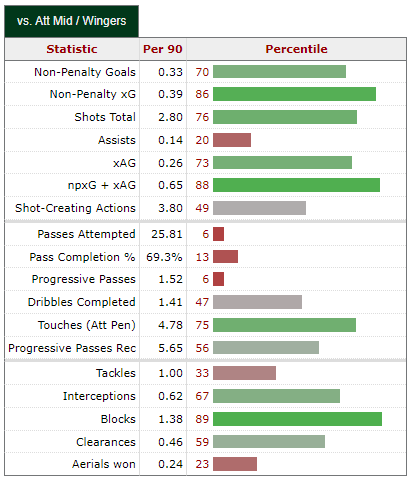
Firstly, just to note that comparisons are made by using FBRef. Comparisons will be made between wingers/attacking midfielders in Europe’s top five leagues and top two continental competitions.
Putting the ball in the back of the net is something he has excelled in this season, his non-penalty expected goals (npxG) scores within the 86th percentile. First of all, this proves he is getting into fantastic scoring opportunities through his dynamic runs and off the ball work. His six goals are a product of this ability to find space and make something happen.
If we combine npxG and expected assisted goals (xAG), then Lindstrøm scores within the 88th percentile. Further proof of his attacking output is why Eintracht Frankfurt are doing so well in the Champions League and also fighting for a top-four position in the Bundesliga.
Not all is rosy, in terms of shot-creating actions he is only in the 49th percentile. While he is now bagging goals, it would be preferable if this aspect of his game were also to improve.
But going back to his ball-striking and it turns out he is remarkably accurate. In the Bundesliga this season, he has a shot on target ratio of 48.3%, which is high by anyone’s standards. However, if we take into account that Christopher Nkunku, arguably the leagues best striker has a SoT ratio of 41.5% then the Danes numbers start to look even more impressive.
The Danish side have a lot of talent and while rotation will be key for them, if Lindstrøm gets minutes then he is set to shine given his current form.
*All statistics taken from FBRef website

 Statswise FC